
Aperture in photography controls the size of the opening inside the lens. That opening affects how much light reaches the sensor and, just as importantly, how much of the scene appears acceptably sharp from front to back.
For beginners, aperture can seem confusing because the numbers work in the opposite direction you might expect: f/1.8 is a wider opening than f/8, while f/16 is narrower. Once that relationship becomes familiar, aperture becomes one of the most useful creative controls on the camera.
This guide focuses on practical decisions: how to blur a background, keep more of a landscape sharp, work in low light, avoid unnecessary diffraction, and choose a sensible starting aperture for different subjects.
Table of Contents
What Is Aperture in Photography?
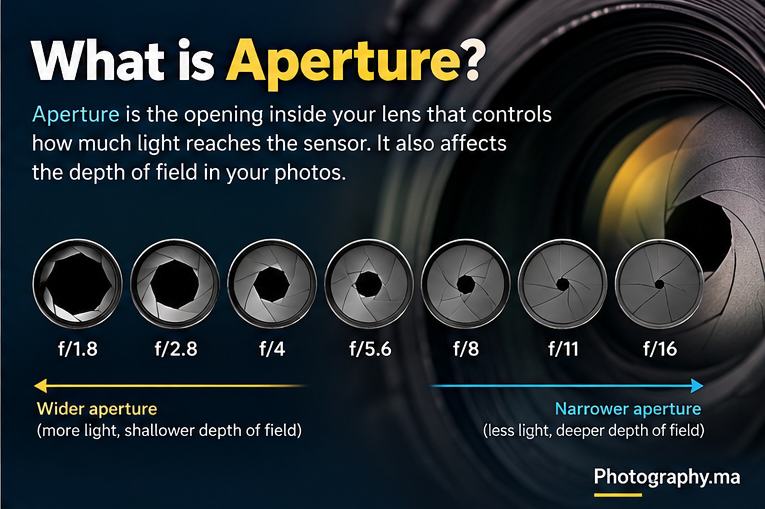
Inside most photographic lenses is an adjustable diaphragm made of overlapping blades. The opening formed by those blades is the aperture. A wider opening lets more light through during the exposure; a narrower opening lets less light through.
Aperture is expressed as an f-number, such as f/1.8, f/2.8, f/4, f/5.6, f/8, f/11 or f/16. The exact available values depend on the lens and camera. The counterintuitive part is worth memorizing: a smaller f-number means a wider aperture, while a larger f-number means a narrower aperture.
For a manufacturer explanation of f-stops and depth of field, see Nikon’s guide to understanding aperture.
Aperture and Light: What Changes?
If shutter speed and ISO remain unchanged, opening the aperture increases the amount of light reaching the sensor. Closing it reduces the light. In real shooting, the camera or photographer may compensate by changing shutter speed or ISO.
For example, in Aperture Priority you choose the aperture and the camera normally adjusts shutter speed to reach its metered exposure. With Auto ISO enabled, ISO may also change depending on the camera and settings. This is why aperture should not be treated only as a brightness control. Its strongest creative effect is often depth of field.
Aperture and Depth of Field
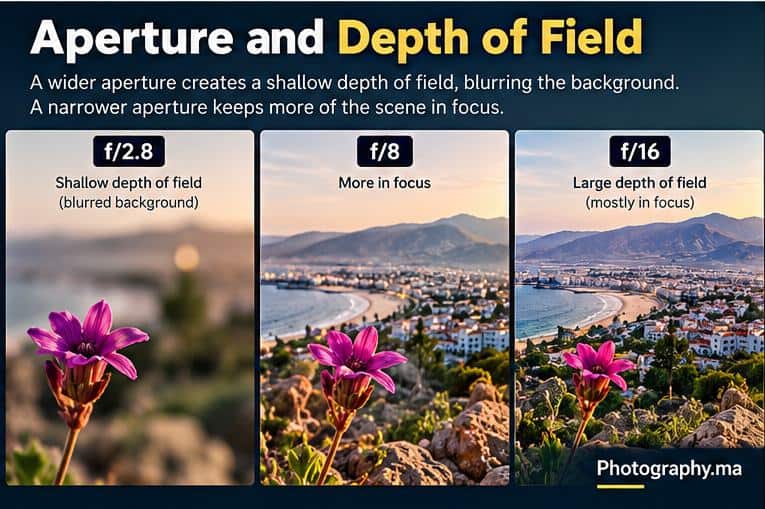
Depth of field is the range of distances that appears acceptably sharp around the point of focus. A wide aperture such as f/1.8 or f/2.8 can produce shallow depth of field, while a narrower aperture such as f/8 or f/11 can make a larger range appear sharp.
But aperture is not the only factor. Depth of field also changes with focusing distance, focal length, sensor format, output size and viewing conditions. Moving closer to a subject can make depth of field much shallower even when the f-number stays the same.
Avoid the shortcut that says “f/2.8 always means a blurry background” or “f/11 means everything is sharp.” The scene and camera position matter.
Why a Wide Aperture Blurs the Background
Portrait photographers often use a wide aperture to separate a person from a distracting background. If the subject is reasonably close and the background is farther away, a setting such as f/1.8, f/2 or f/2.8 can make the background softer.
Background blur becomes stronger when you move closer to the subject, increase the distance between subject and background, or use a longer focal length from an appropriate shooting position. Aperture is only one part of that look.
Very shallow depth of field also creates a risk: one eye may be sharp while the other falls outside the acceptable focus zone. Wider is not automatically better.
Best Aperture for Portraits
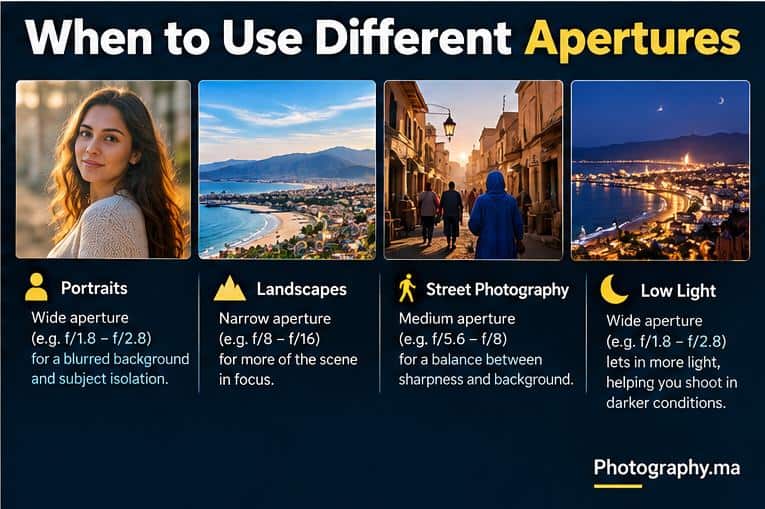
For one person, start around f/2.8 or f/4 if your lens allows it. This often gives useful subject separation while providing more focusing tolerance than shooting at the lens’s widest setting.
For a tightly framed portrait with both eyes on different planes, inspect focus carefully. If several people must be sharp, use a narrower aperture and arrange them at similar distances from the camera when possible.
Best Aperture for Landscapes
Many landscapes work well around f/5.6 to f/11, but there is no universal “landscape aperture.” If the nearest important object is far away, f/5.6 may provide enough depth of field. If a foreground element is close and a distant background must also appear sharp, you may need a narrower aperture, different focus placement or focus stacking.
Do not automatically choose f/16 or f/22. Very small apertures increase depth of field but can also soften fine detail through diffraction.
What Is Diffraction?
Diffraction is an optical effect that becomes more noticeable as the aperture gets very small. Instead of light forming an increasingly precise point, wave behavior causes some spreading, which can reduce fine detail across the image.
There is no single f-number where every camera suddenly becomes soft. Sensor pixel density, lens design, viewing size and sharpening all affect how noticeable diffraction appears. Treat f/16 or f/22 as tools to use when the depth-of-field or shutter-speed benefit matters—not as default settings for maximum sharpness.
Does a Lens Have One Sharpest Aperture?
Lenses often perform differently across their aperture range. A lens may improve away from its widest setting and later lose some fine detail as diffraction increases. But chasing a theoretical “sweet spot” is less important than choosing the aperture the photograph needs.
A perfectly sharp background at f/8 does not help if you wanted it blurred. Likewise, avoiding f/16 makes little sense if the extra depth of field is essential to the composition.
Aperture in Low-Light Photography
A wide aperture can help in low light because it allows more light through the lens. That can let you use a faster shutter speed or a lower ISO than a narrower aperture would permit under the same conditions.
The tradeoff is shallower depth of field. For a single subject, that may be desirable. For a group or a scene where several distances matter, opening the lens too far can solve the exposure problem while creating a focus problem.
Choose aperture for the depth of field you need, then use shutter speed and ISO to finish the exposure decision.
Aperture Priority: The Easiest Mode for Learning Aperture
Aperture Priority—usually marked A or Av—lets you choose the aperture while the camera calculates an appropriate shutter speed according to its metering and other automatic settings. This makes it an excellent learning mode because you can concentrate on depth of field without manually controlling every exposure variable.
Watch the shutter speed while you work. If you close the aperture and the camera responds with a shutter speed that is too slow for handheld shooting or subject movement, raise ISO, open the aperture, stabilize the camera or change your approach.
Aperture, Autofocus and Sharpness
Aperture does not decide where the camera focuses. Autofocus mode and focus-area selection handle that task. Aperture determines how much acceptable sharpness extends around the focused distance.
This distinction explains a common problem: autofocus can land perfectly on one eye, yet the second eye is soft because the chosen aperture and shooting distance created very shallow depth of field.
Aperture and Bokeh Are Related, but Not Identical
Bokeh describes the visual character of out-of-focus areas, not simply how blurry the background is. A wider aperture can increase background blur, but the appearance of that blur also depends on lens design, aperture blades, optical corrections, highlights in the background and subject-to-background distance.
Do not choose a lens based only on the lowest f-number if your real goal is attractive subject separation. Consider focal length, working distance and the background you actually have available.
Related guide: ISO, Aperture, and Shutter Speed Explained
Portrait depth-of-field examples: Portrait Photography Tips for Beginners
Landscape depth-of-field decisions: Landscape Photography Tips for Beginners
Exposure correction in Aperture Priority: Exposure Compensation Explained
Focus selection: Autofocus Modes Explained
Common Aperture Mistakes Beginners Make
- Using the widest aperture for every portrait. Shallow depth of field can make important facial features or multiple people soft.
- Using f/16 or f/22 automatically for every landscape. More depth of field can come with diffraction and unnecessarily slow shutter speeds.
- Changing aperture without watching shutter speed. In Aperture Priority, closing the lens can push shutter speed low enough to cause camera shake or subject blur.
- Assuming aperture alone controls background blur. Subject distance, background distance and focal length matter too.
- Confusing missed focus with insufficient depth of field. First identify where the camera focused, then decide whether the aperture provided enough tolerance.
A 10-Minute Aperture Exercise
- Choose a stationary subject with a detailed background several meters behind it.
- Use Aperture Priority and keep camera position and framing consistent.
- Photograph at the lens’s widest available aperture.
- Repeat at f/4, f/5.6, f/8 and f/11 when available.
- Compare background blur and how much of the subject appears sharp.
- Watch how shutter speed changes as you close the aperture.
- Move closer and repeat two settings to see how focusing distance changes depth of field.
This comparison teaches more than memorizing a list of f-numbers because it shows how aperture behaves with your own camera, lens and shooting distance.
Quick Aperture Decision Guide
- Want stronger subject separation → try a wider aperture and increase subject-to-background distance.
- Need several people sharp → use a narrower aperture and keep faces near the same focus plane.
- Need near-to-far landscape detail → start around f/8 and evaluate the scene.
- Shutter speed becomes too slow → open the aperture, raise ISO or stabilize the camera.
- One part of the subject is sharp but another is not → increase depth of field or change shooting distance.
FAQ
What aperture should a beginner use?
There is no single beginner aperture. f/4 to f/5.6 is a flexible starting range for many subjects, while portraits, landscapes, groups and low-light scenes may need different choices.
Is f/1.8 better than f/4?
Not generally. f/1.8 admits more light and can create shallower depth of field; f/4 gives greater depth of field and may make it easier to keep more of the subject sharp.
What aperture gives the sharpest photo?
That depends on the lens and on what you mean by sharp. Total image sharpness also depends on focus, shutter speed, subject movement and required depth of field.
What aperture should I use for a blurry background?
Start with a wide aperture such as f/1.8 to f/2.8 if your lens provides it, but also move closer to the subject and keep the background farther behind the subject when possible.
Is f/16 bad?
No. f/16 is useful when you genuinely need more depth of field or a slower shutter speed. It simply carries a greater diffraction tradeoff than wider apertures on many systems.
Final Takeaway
Aperture in photography is most useful when you connect f-numbers to the photograph you want. Use wider apertures when you need more light or shallower depth of field. Use narrower apertures when more of the scene needs to appear sharp. Then watch shutter speed, ISO and focus so the aperture solves one problem without creating another.The best aperture is not the smallest number or a universal “sweet spot.” It is the aperture that gives your subject the depth of field and exposure flexibility the image requires.
13 thoughts on “Aperture in Photography: A Beginner’s Guide to Depth of Field”
Comments are closed.