
Focal length in photography determines how much of a scene fits into your frame at a given camera position. It is one of the most useful concepts to understand when choosing a lens, photographing a portrait, or deciding how to capture a landscape.
A 24mm lens and an 85mm lens can photograph the same subject, but they do not frame it in the same way from one spot. Yet the difference people call “lens compression” is often caused by moving the camera, not by the focal length alone. This guide separates field of view, perspective, framing and depth of field so you can make deliberate choices.
Table of Contents
What Is Focal Length in Photography?
Focal length is an optical property of a lens, expressed in millimeters. In everyday use, it helps describe the lens’s angle of view: shorter focal lengths generally show a wider area, while longer focal lengths show a narrower area on the same sensor format.
Focal length is not the physical length of the lens barrel. A 50mm lens may be physically shorter or longer than another 50mm lens, depending on its optical design.
How Focal Length Changes Your Field of View
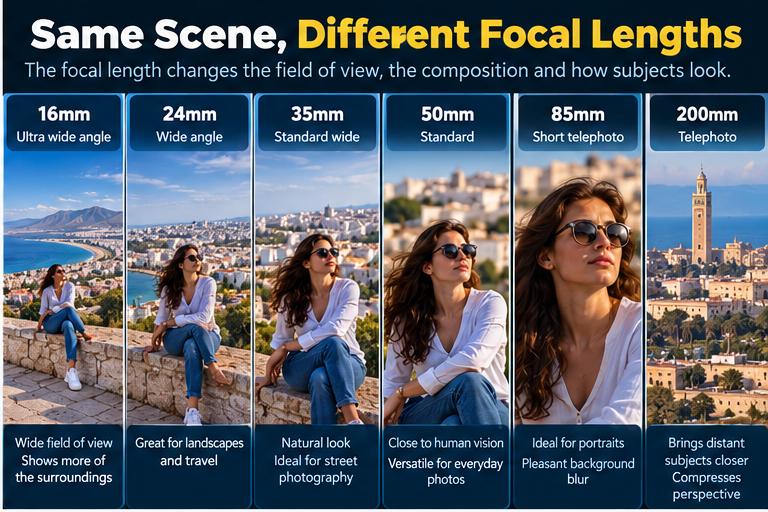
Stand in one position and take pictures at 16mm, 24mm, 35mm, 50mm, 85mm and 200mm. The wider setting includes more surroundings. As the number increases, the subject occupies more of the frame and the visible background becomes narrower. This is the most direct effect of changing focal length.
A crucial qualification: this comparison assumes the same sensor format and camera position. On a smaller sensor, the same focal length records a narrower field of view than on full frame.
A Practical Guide to Common Focal Lengths
For real-world subject examples, see our portrait photography tips for beginners
| Full-frame focal length | Typical framing | Useful starting point |
| 16mm | Ultra-wide | Interiors, expansive scenes, dramatic foregrounds |
| 24mm | Wide | Travel, architecture, landscapes |
| 35mm | Moderately wide | Street, documentary, environmental portraits |
| 50mm | Normal | Everyday photography, portraits with context |
| 85mm | Short telephoto | Head-and-shoulders portraits, subject separation |
| 200mm | Telephoto | Sports, wildlife, distant details |
These categories are approximate and assume full-frame equivalence. There is no rule that says portraits must be shot at 85mm or landscapes at 24mm.
Wide-Angle Lenses: 16mm to 35mm
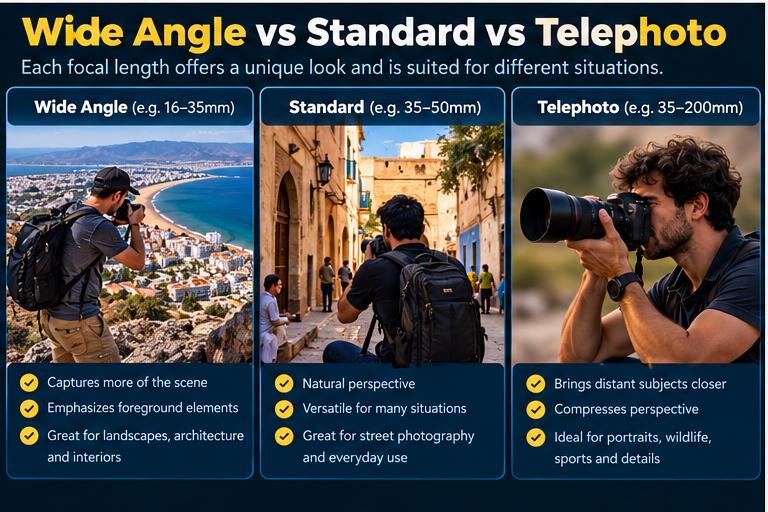
Wide-angle lenses help you show the environment. They are excellent for small interiors, dramatic architecture and landscapes where foreground and background are both important. They also let you work close to people while retaining contextual details.
The main trap is moving too close to a face. From very short distances, nearby features appear relatively large compared with features farther away. This is a perspective effect produced by camera position, not a defect inherent to wide-angle glass.
Standard Lenses: Around 35mm to 50mm
Understanding focal length in photography helps you choose between a wider environmental shot and a tighter composition.
A moderate wide or normal focal length is versatile because it can balance subject and surroundings. A 35mm lens suits documentary and street photography when context matters. A 50mm lens gives a narrower frame and can simplify busy backgrounds without forcing you to stand extremely far away.
For beginners with a kit zoom, try setting the lens to one focal length for an entire walk. You will learn where to stand and how to anticipate framing rather than zooming reflexively.
Telephoto Lenses: 85mm to 200mm and Beyond
Telephoto focal lengths frame distant subjects more tightly. They are useful for portraits, sports, wildlife and isolating details in landscapes. A longer lens can also help simplify the background by excluding distracting elements outside its narrower field of view.
Telephotos magnify camera shake, so shutter speed and stabilization matter. When shooting action, prioritize the shutter speed needed to freeze movement rather than keeping ISO artificially low.
Focal Length vs Perspective: The Most Important Distinction
For stronger framing and subject placement, see our guide to composition in photography
Perspective is governed by the camera’s position relative to the subject and background. If you photograph a person from the same spot using 35mm and 85mm, then crop the 35mm photograph to match the 85mm framing, the relative sizes and spatial relationships remain essentially the same.
If instead you move backward with the 85mm lens to keep the person the same size, the camera-to-subject and camera-to-background distances change. The background can appear relatively larger. This is the effect commonly called perspective compression.
Therefore, choose camera position first for the relationship you want between subject and background. Then choose a focal length that gives the framing you need from that position.
Does Focal Length Affect Background Blur?
For a deeper explanation of f-stops and background separation, read our guide to aperture in photography
It can influence the appearance of background blur, but the result also depends on aperture, focus distance, background distance, sensor format and how you match framing. A longer focal length at the same camera position usually gives a tighter crop and may show more blur; moving back to maintain identical framing changes the comparison.
If your goal is a blurred portrait background, try increasing subject-to-background distance and using a suitable aperture before assuming that a new lens is essential.
Full Frame, APS-C and Crop Factor
For further information about lenses and camera systems, explore Nikon’s official photography resources
A lens retains its actual focal length when attached to a different sensor format. What changes is the field of view captured by the sensor. A 35mm lens on an APS-C camera with a 1.5× crop factor gives a field of view similar to approximately 52.5mm on full frame. On a 1.6× APS-C system, it resembles approximately 56mm.
A 50mm lens on 1.5× APS-C provides framing similar to 75mm on full frame. It does not literally become a 75mm lens. When reading focal-length recommendations, always check whether they refer to full-frame equivalent focal length.
Zoom Lens vs Prime Lens
A prime lens has a fixed focal length. A zoom lens offers a range, such as 18–55mm or 24–70mm. Primes are often available with wider maximum apertures, while zooms let you reframe quickly without changing lenses.
Neither type automatically makes a better photograph. Choose based on your subject, lighting, portability and whether you value flexibility or a particular aperture and focal length combination.
Choosing Focal Length for Different Subjects
The best focal length in photography depends on your subject, available space and the perspective you want to create.
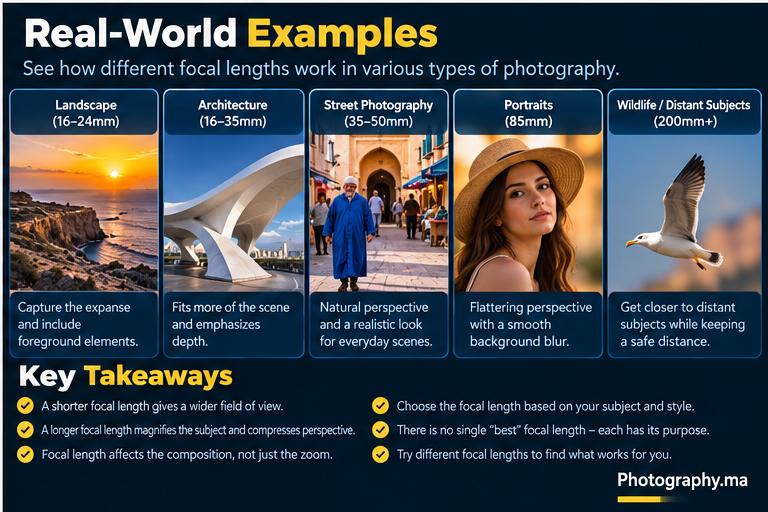
- Landscapes: start around 16–35mm equivalent for broad scenes, but try telephoto for distant layers and isolated details.
- Architecture: a wide lens can fit a building into a tight space; check converging verticals and edge distortion.
- Street photography: 35mm or 50mm equivalent can be a practical starting point, depending on working distance.
- Portraits: 50–85mm equivalent often provides comfortable working distance; environmental portraits may work beautifully at 35mm.
- Sports and wildlife: longer lenses help fill the frame from a safe or practical distance; available light and autofocus performance also matter.
Common Beginner Mistakes
- Confusing focal length with physical lens size.
- Assuming a long lens alone changes perspective while the camera stays fixed.
- Comparing focal lengths without accounting for crop factor.
- Standing too close to a face with a wide lens and blaming the resulting proportions on optical distortion.
- Buying a telephoto before considering working distance, shutter speed and weight.
- Assuming wide-angle is always best for landscapes or 85mm is mandatory for portraits.
A Five-Minute Focal Length Exercise
Find a stationary subject with a visible background. From one marked position, photograph it at the shortest, middle and longest settings on your zoom. Notice how the field of view changes. Next, move your camera until the subject fills roughly the same proportion of each frame. Compare how large background objects appear relative to the subject.
For a second test, photograph a person at 35mm and 85mm equivalent while keeping the face the same size by moving your feet. Look at the relative size of the nose, ears and background. The changing camera distance is the lesson.
FAQ
Is 50mm better than 35mm?
Neither is universally better. A 35mm equivalent lens shows more environment; a 50mm equivalent lens frames more tightly from the same position.
What focal length is best for portraits?
Around 50–85mm full-frame equivalent is a common starting range, but the ideal choice depends on framing, working distance and creative intent.
Does a 200mm lens make the background look closer?
If you move farther away to keep the subject similarly framed, the change in camera position alters perspective and makes the background appear relatively larger.
Does crop factor change focal length?
No. It changes the recorded field of view, not the lens’s actual focal length.
Final Takeaway
Focal length in photography is primarily a way to control framing and field of view. Perspective comes from where you place the camera. Once you separate these two ideas, choosing between a wide-angle, normal or telephoto lens becomes much easier.
1 thought on “Focal Length in Photography: A Beginner’s Guide”
Comments are closed.