

Composition in photography is the way you arrange subjects, lines, shapes, light, space and background elements inside the frame. Camera settings control how a photograph is recorded; composition controls what the viewer notices first and how the eye moves through the image.
Beginners often look for a list of rigid rules. A better approach is to treat composition techniques as tools. The rule of thirds may improve one scene, while symmetry or a centered subject may be stronger in another. The goal is not to obey a grid—it is to make the subject clear and remove distractions.
This practical guide shows you how to use the rule of thirds, leading lines, framing, symmetry, patterns, negative space, balance, layers and perspective, then apply them to portraits, landscapes, street photography and architecture.
Table of Contents
What Is Composition in Photography?
Composition is the deliberate arrangement of visual elements within the frame. It includes where the main subject sits, how much space surrounds it, what appears in the foreground and background, and whether lines, color, contrast or light guide attention.
A technically perfect photograph can still feel confusing if the viewer does not know where to look. Strong composition creates hierarchy: one element usually becomes the main point of attention while supporting elements provide context, depth or visual flow.
Nikon describes composition as the framing decisions you make when creating a picture and presents common guidelines as starting points rather than absolute laws. See Nikon’s 5 Easy Composition Guidelines.
1. Use the Rule of Thirds as a Starting Point
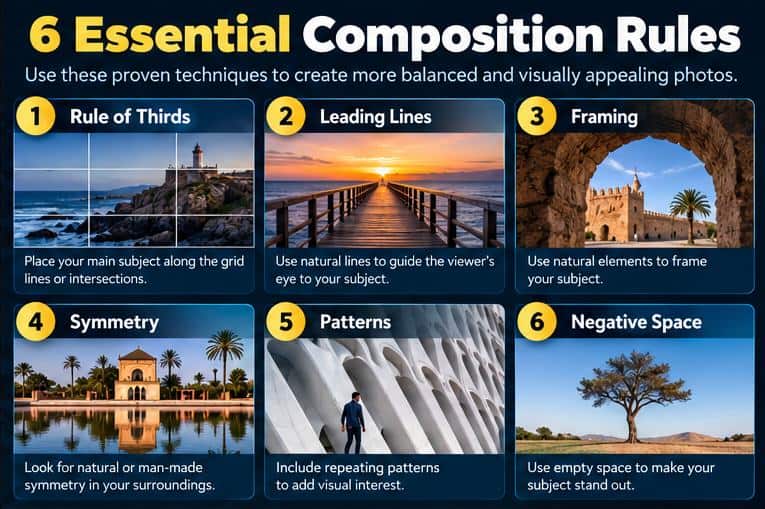
Imagine the frame divided into a 3×3 grid. The rule of thirds suggests placing important subjects near the grid lines or their intersections. This often creates space around the subject and makes the frame feel less static.
For a portrait, an eye can sit near an upper intersection. In a landscape, the horizon can be placed near the upper or lower third depending on whether the sky or foreground deserves more attention.
But centering is not a mistake by definition. Symmetrical scenes, reflections, architecture and direct portraits can become stronger when the subject is centered. Use the grid to make a decision, not to avoid the center automatically.
2. Use Leading Lines to Guide the Viewer
Roads, paths, railings, shorelines, shadows, walls and architectural edges can direct the eye through a photograph. A leading line is most effective when it supports the subject instead of pulling attention out of the frame.
Before shooting, trace the strongest lines with your eyes. Ask where they begin, where they end and whether they lead toward the point of interest. Moving a few steps left or right can completely change their direction.
Leading lines are one of the simplest ways to strengthen composition in photography because they give the viewer a clear path through the frame.
3. Frame the Subject With the Scene
Natural or architectural elements can form a frame within the frame: an arch, doorway, window, tree branch, shadow or gap between foreground objects. Framing can isolate the subject and add context.
The frame does not need to surround the subject on all four sides. Even one dark foreground element can create depth and direct attention. Avoid making the framing element so bright or detailed that it competes with the subject.
4. Look for Symmetry — and Know When to Break It
Symmetry works especially well with architecture, reflections, corridors and repeating structures. When symmetry is the reason the scene is interesting, careful centering can make the geometry feel deliberate.
Perfect symmetry is not mandatory. An asymmetrical frame can still feel balanced when a large subject on one side is visually counterweighted by a smaller bright object, strong color, textural area or negative space on the other.
5. Use Patterns, Repetition and Interruptions
Repeating windows, tiles, chairs, shadows, trees or shapes create rhythm. A pattern can become the subject itself, particularly when you simplify the frame.
A break in the pattern often becomes an immediate focal point: one person among repeating columns, one differently colored object, or one illuminated window in a dark facade. Look for both repetition and the exception.
6. Use Negative Space to Make the Subject Stronger
Negative space is the relatively empty area around the main subject. Sky, water, a plain wall, fog or a clean shadow can provide visual breathing room.
This is particularly useful when the subject has a distinctive shape or when you want a calm, minimal image. Empty space is not wasted space when it helps establish scale, mood or direction.
7. Simplify the Background
One of the fastest ways to improve composition in photography is to inspect the background before pressing the shutter. Beginners naturally concentrate on the subject and overlook poles, bright signs, branches or people that appear to grow out of it.
Move sideways, crouch, raise the camera, change focal length or wait a moment. Often the best composition change is not adding something—it is removing a distraction.
8. Build Depth With Foreground, Middle Ground and Background
A photograph can feel more three-dimensional when elements exist at different distances. A foreground rock, person or architectural detail can give scale to a landscape while a middle-ground subject connects the foreground to the distant background.
Do not add foreground merely because landscape advice says you should. It must support the scene. If it is visually heavy or unrelated, it can weaken the photograph.
For practical landscape application, see Landscape Photography Tips for Beginners.
9. Change Your Angle and Perspective

If your first photograph is made from normal standing height, treat it as a starting point. Walk around the subject. Get lower, shoot from higher ground, move closer or step farther back.
A low angle can make a person or structure appear more dominant and can remove a cluttered ground from the background. A high angle can reveal patterns and relationships that are invisible at eye level. Moving close can emphasize texture; moving back can show context.
Perspective changes primarily when you change camera position. Simply zooming from the same position changes framing, but it does not create the same spatial relationship as physically moving.
10. Use Space in the Direction of Movement or Gaze
When a person, animal or vehicle faces or moves across the frame, leaving more space in front of it often feels natural because the viewer can anticipate where it is going.
Breaking this convention can create tension. A subject looking toward the nearest edge can feel confined or uneasy. That may be exactly what you want, but make it deliberate.
11. Pay Attention to the Edges
Scan all four edges before shooting. Look for half-visible people, clipped objects, bright corners, awkward branches and accidental tangencies where two shapes just touch.
Small edge distractions can compete strongly because they interrupt the frame. A tiny camera movement can often eliminate them without changing the main composition.
12. Use Light and Contrast as Composition Tools
The brightest or highest-contrast part of an image often attracts attention. This means composition is not only about where objects sit; it is also about where light falls.
If the background is much brighter than the subject, the eye may leave the subject. Changing viewpoint, waiting for different light or adjusting exposure can simplify the visual hierarchy.
When brightness differences become difficult to manage, Photography.ma’s Dynamic Range in Photography guide explains how to protect highlights and shadows.
Composition in Portrait Photography
Start with the eyes and expression, then inspect everything around the person. Keep distracting lines away from the head, avoid awkward crops at major joints, and decide whether the environment adds useful context.
A shallow depth of field can simplify a background, but composition should still work without relying entirely on blur. Position the subject relative to light, lines and background shapes first.
For more portrait-specific practice, read Portrait Photography Tips for Beginners.
Composition in Landscape Photography
Decide what attracted you to the scene before choosing a lens. Is it the sky, a mountain, a coastline, a reflection, a foreground shape or the relationship between several layers?
Use leading lines and foreground elements only when they strengthen that idea. If the sky is uninteresting, reduce its space. If dramatic clouds are the subject, give them more room. Composition should reflect what matters in the scene.
Good composition in photography does not require a complicated scene; a simple foreground, clear subject and well-placed horizon can often create a stronger landscape.
Composition in Street Photography

Street scenes change quickly, so composition often depends on anticipation. Find a strong background, patch of light, doorway, reflection or repeating structure, then wait for a person to enter the right position.
Layers can add context, but clutter can overwhelm the subject. Watch edges carefully and take several frames as people move through the geometry of the scene.
Composition in Architecture
Architecture rewards precision. Check verticals, symmetry, repeating shapes and how the building interacts with surrounding space. A central composition can work beautifully when symmetry is strong, while a diagonal or low angle can emphasize height and perspective.
Do not assume the entire building must fit in the frame. Details, patterns and abstract sections can produce stronger photographs than a straightforward record shot.
Common Composition Mistakes
- Centering every subject automatically instead of deciding why it belongs there.
- Using the rule of thirds mechanically even when symmetry or centering is stronger.
- Ignoring the background while concentrating on the subject.
- Adding foreground elements that do not contribute to the photograph.
- Leaving bright distractions near the frame edges.
- Cropping people awkwardly at major joints.
- Using too many competing points of interest.
- Shooting every scene from normal standing height.
- Trying to apply several composition techniques at once instead of clarifying one visual idea.
A Simple Composition Workflow Before You Press the Shutter
- Identify the real subject: what made you stop?
- Decide what should attract the viewer first.
- Check the background and all four edges.
- Move left, right, higher, lower, closer and farther to test perspective.
- Look for useful lines, frames, patterns, layers or negative space.
- Decide whether thirds, symmetry or centering best supports the scene.
- Take the photograph, then make one deliberately different composition before leaving.
10-Minute Composition Exercise
Choose one simple subject and make at least eight photographs without changing the subject itself.
- One centered composition.
- One rule-of-thirds composition.
- One with strong negative space.
- One using a foreground frame.
- One from a very low angle.
- One from a higher angle.
- One close-up that removes most context.
- One wider frame that shows the environment.
Compare the images at normal viewing size. Do not ask which one follows the most rules. Ask which one makes the subject clearest and creates the strongest visual response.
FAQ
What is the most important rule of composition?
There is no single most important rule. Subject clarity is more useful than mechanically following a grid. The rule of thirds, leading lines, framing and symmetry are tools for organizing the frame.
Should beginners always use the rule of thirds?
No. It is a useful starting point, but centered and symmetrical compositions can be stronger in many scenes.
How can I improve composition quickly?
Slow down, inspect the background and edges, then change your physical position before changing equipment. Make several different compositions of the same subject.
Does a better camera improve composition?
Not directly. Composition depends mainly on observation, timing, viewpoint and framing. Different lenses can change your options, but they do not decide what belongs in the frame.
Can composition rules be broken?
Yes. Breaking a convention can create tension, emphasis or originality. The important part is understanding what the convention normally does so the alternative feels intentional.
Final Takeaway
Composition in photography is less about memorizing rules than learning to make deliberate choices. Decide what the photograph is about, remove what competes with that idea, and use lines, space, light, perspective and timing to guide attention.
Practice one technique at a time, then combine them naturally. The strongest frame is not the one that follows the most composition rules—it is the one where every important element feels intentional.
2 thoughts on “Composition in Photography: A Beginner’s Guide to Better Photos”