
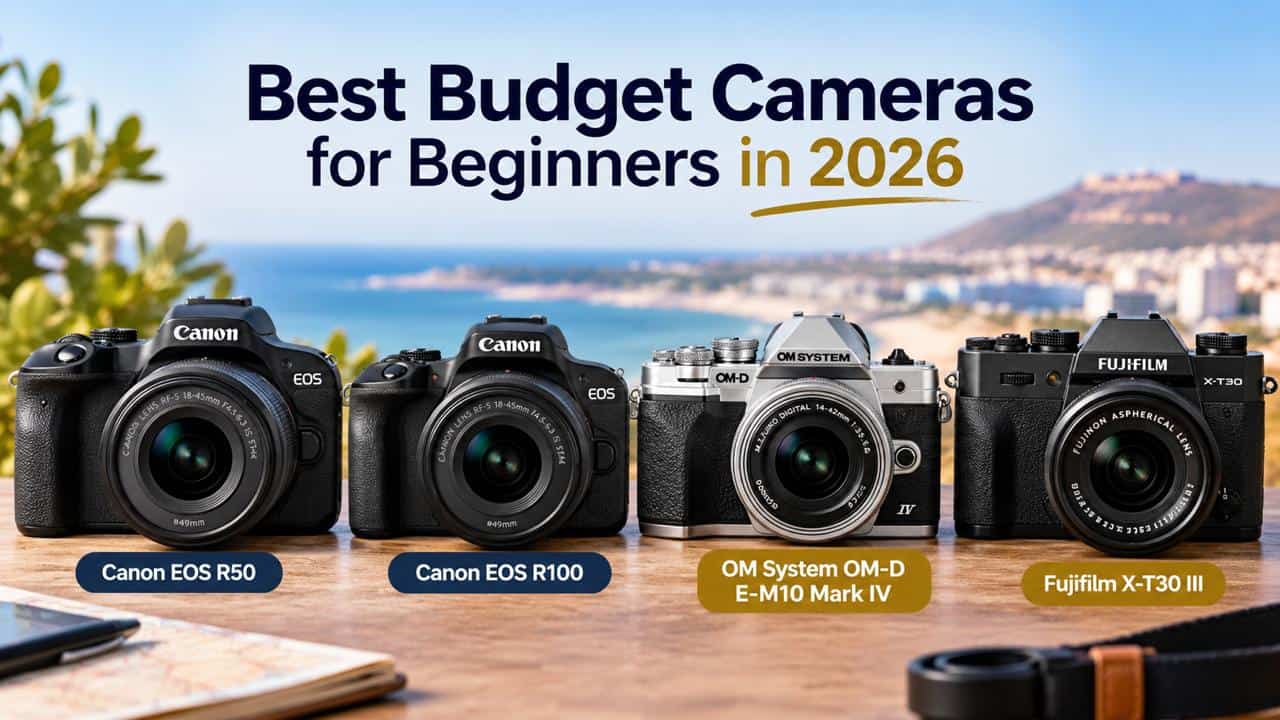
Buying your first interchangeable-lens camera is less about finding the model with the longest specification sheet and more about choosing a system that fits what you photograph, what you can comfortably carry, and what you can afford after the camera body.
Finding the best budget cameras for beginners means looking beyond price and choosing a camera system you can grow with.
For most beginners, the Canon EOS R50 is the strongest all-round starting point in this shortlist because it combines a lightweight body, an electronic viewfinder, an articulating touchscreen, and capable autofocus. The Canon EOS R100 is the lower-cost alternative when purchase price matters more than interface refinements or advanced tracking. The OM System OM-D E-M10 Mark IV stands out for in-body stabilization and a compact Micro Four Thirds system. The Fujifilm X-T30 III is the stretch-budget choice for photographers who value compactness, physical controls, in-camera JPEG options, and a broad APS-C lens ecosystem.
There is no single best camera for every beginner. The useful question is: which compromises matter least for the photography you want to do?
Best Budget Cameras for Beginners: Quick Comparison
| Camera | Best for | Sensor | IBIS | EVF | Weight | Main advantage | Main compromise |
| Canon EOS R50 | Most beginners | 24.2MP APS-C | No | Yes | 375g with battery/card | Accessible controls and capable subject-detection AF | No IBIS; native RF-S choice is less extensive than some rival systems |
| Canon EOS R100 | Lower-cost new entry | 24.1MP APS-C | No | Yes | Compact entry-level body | Low-cost route into the RF system | Fixed non-touch screen and more basic autofocus |
| OM System OM-D E-M10 Mark IV | Stabilization and compact system | 20.3MP Micro Four Thirds | Yes, 5-axis | Yes | 335g body only | IBIS and a mature compact-lens ecosystem | Older contrast-detection AF |
| Fujifilm X-T30 III | Photography-first stretch budget | 26.1MP APS-C | No | Yes | 378g with battery/card | Compact controls, 20 Film Simulations, current subject detection and broad X-mount choice | Higher starting cost and no sensor-shift IBIS |
Weights are stated on the same basis used by the cited manufacturer where possible; body-only and ready-to-shoot figures should not be compared as if they were identical measurements. Prices and stock vary by country and promotion, so always check the exact body and kit available in your market.
How we chose these cameras
Photography.ma has not tested these cameras firsthand. This shortlist is based on current manufacturer specifications and availability information, system-level considerations, and reputable independent testing where practical performance matters.
We evaluated each camera for price, still-photography capability, autofocus, stabilization, ergonomics, size and weight, lens ecosystem, video where relevant, likely total system cost, and room to grow. We also kept the shortlist deliberately short: a camera is included only when it serves a distinct beginner need.
What “budget” means here
“Budget” is relative in interchangeable-lens photography. For this guide, think broadly in terms of an initial purchase in the mid-hundreds to around $1,000, while treating the Fujifilm as a deliberate stretch-budget option. That is an editorial framework, not a universal definition.
The body price is only part of the cost. A cheaper body that requires a more expensive lens for your intended photography can become the more expensive system.
As a September 2026 US snapshot, Canon’s store catalog lists the EOS R100 body at $429.99 and its RF-S 18-45mm kit at $549.99. OM System lists the E-M10 Mark IV from $799.99 and the 14-42mm EZ kit at $899.99. These are time- and market-specific examples, not permanent prices. Fujifilm’s regional official stores also show that the X-T30 III sits at the upper edge of this guide; for example, Fujifilm Austria lists the body from €949 and the XC13-33mm kit from €1,099. Local pricing may differ substantially.
Among the best budget cameras for beginners, ease of use, autofocus, lens choice, and total system cost matter more than specifications alone.
Canon EOS R50 — Best Overall for Most Beginners
The Canon EOS R50 is the easiest camera in this shortlist to recommend to a beginner who does not yet have a highly specialized requirement.
It uses a 24.2MP APS-C sensor and Canon’s Dual Pixel CMOS AF II system. It has an electronic viewfinder, a fully articulating touchscreen, and weighs approximately 375g in black with battery and memory card. Those features make it approachable without reducing it to a camera you will immediately outgrow.
Why it works well as a first camera
A first camera should make basic photography easy while still allowing the photographer to take more control later.
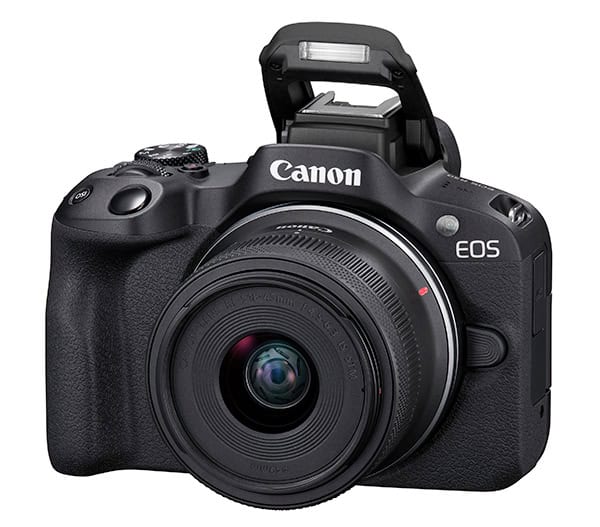
The R50 does this well. Beginners can start with automatic modes and touch controls, then move into aperture priority, shutter priority, manual exposure, RAW capture, and more deliberate autofocus settings as their skills develop
Its electronic viewfinder is useful in bright conditions, while the articulating screen makes low-angle, high-angle, and self-facing compositions easier than they are with a fixed display.
Independent testing by RTINGS describes the R50 as portable and intuitive, with an effective autofocus system. That supports its role here, but the recommendation is Photography.ma’s editorial synthesis rather than a claim of first-party testing.
Autofocus and moving subjects
Canon lists subject-detection options for people, animals, and vehicles on the R50. Its Whole Area AF and subject-detection functions can reduce the need for a beginner to place a small focus point manually for every frame.
That is useful for family photography, portraits, pets, travel, and casual action. It does not turn the R50 into a specialist sports body. RTINGS testing also shows that burst depth and sustained action are not its strongest areas.
The compromises
The R50 does not have sensor-shift in-body image stabilization. Stabilization therefore depends on a stabilized lens where available, appropriate shutter speed, and good technique.
The RF mount accepts RF-S and full-frame RF lenses. EF and EF-S DSLR lenses can also be used with a compatible Canon mount adapter. However, the native RF-S catalog is less extensive than mature systems such as Fujifilm X or Micro Four Thirds, so check the actual lenses you expect to buy rather than judging the system from the body alone.
Who should buy it — and who should skip it
Choose the R50 if you want a balanced first camera for family, portraits, travel, everyday photography, pets, and learning photography without a steep equipment barrier.
Consider another option if your budget is extremely tight, if sensor-shift IBIS is a priority, or if a different lens ecosystem better matches your long-term plans.
Canon EOS R100 — Best for a Lower-Cost New Entry
The EOS R100 serves a different buyer from the R50: someone who wants a new interchangeable-lens camera with an electronic viewfinder while keeping the initial cost down.
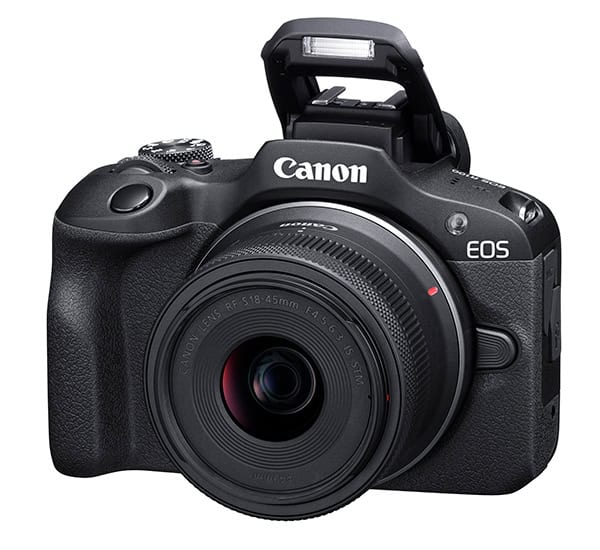
Canon’s current US mirrorless-camera catalog still lists the R100 body and kit as in stock in September 2026, although individual Canon product pages can display conflicting “no longer available” messaging. Availability should therefore be checked in the buyer’s own market rather than assumed from a single regional product page.
The camera uses a 24.1MP APS-C sensor, DIGIC 8 processor, and Dual Pixel CMOS AF for still photography. It provides the core exposure controls and RAW capture needed to learn photography, but its lower price comes with meaningful compromises.
What you still get
For landscapes, travel, portraits, still life, and everyday subjects that are not moving unpredictably, the R100 provides the fundamentals: an APS-C sensor, interchangeable RF/RF-S lenses, an electronic viewfinder, RAW capture, and manual exposure control.
RTINGS testing finds good overall image quality and much stronger AF-C performance when a single center focus point is used than when the camera is asked to track erratic movement.
What you give up compared with the R50
The rear screen is fixed and is not touch-sensitive. That is a noticeable usability compromise for anyone arriving from a smartphone and makes low- or high-angle shooting less convenient.
Its autofocus system is also less sophisticated. Canon specifies Dual Pixel CMOS AF for stills and Full HD/HD video, but 4K recording uses contrast-detection autofocus. RTINGS found its tracking less dependable with erratic subjects than the more advanced systems in pricier mirrorless cameras.
Video is another clear limitation: Canon specifies cropped 4K at up to 24 fps. If video or vlogging matters, the R100 is not the strongest choice in this shortlist.
R100 vs R50: when saving money makes sense
Do not compare these cameras by body price alone.
If a promotion puts an R50 kit only modestly above an equivalent R100 kit, the R50’s touchscreen, articulating display, stronger subject detection, and better hybrid capability can justify the extra cost.
The R100 makes more sense when the budget ceiling is firm and the savings are large enough to matter. If buying the R50 would leave no budget for a useful lens, memory card, spare battery, or actual photography, the simpler body can be the more rational purchase.
Who should buy it — and who should skip it
Choose the R100 if your priority is keeping the cost of a new mirrorless system low while retaining an EVF and the core controls needed to learn still photography.
Skip it if you photograph children, pets, or sports frequently, expect smartphone-like touch interaction, want a movable screen, or care significantly about video.
OM System OM-D E-M10 Mark IV — Best for Stabilization and a Compact Lens System
The OM-D E-M10 Mark IV offers something neither Canon above provides: five-axis in-body image stabilization.
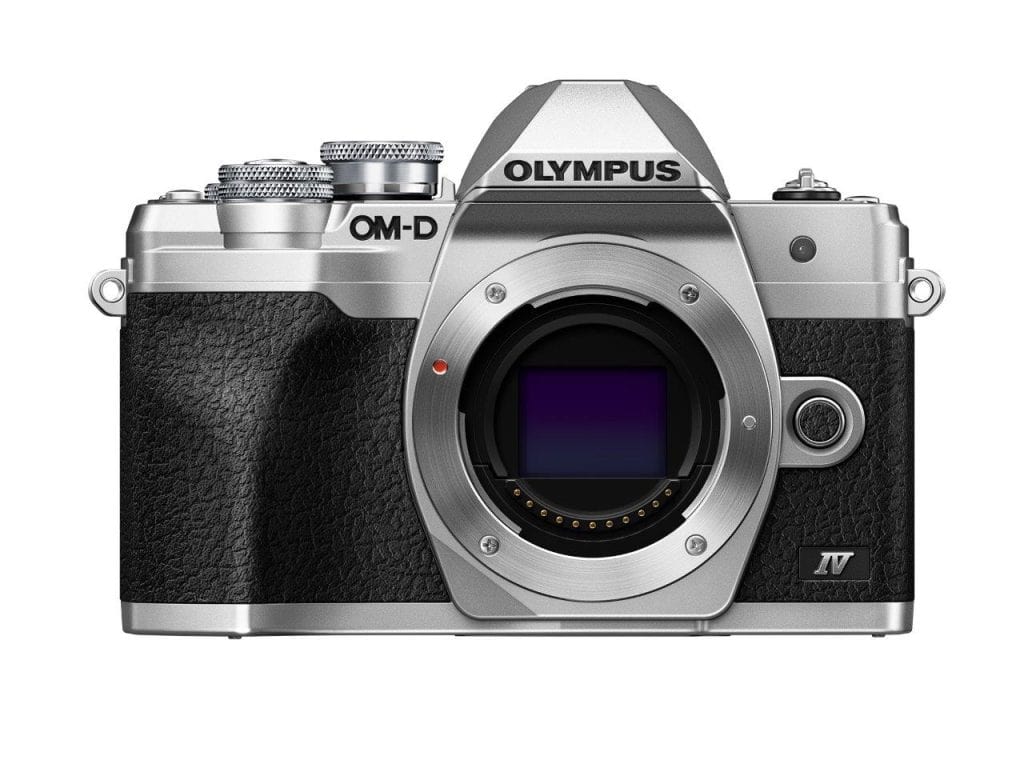
It combines a 20.3MP Micro Four Thirds sensor with an electronic viewfinder, a tilting touchscreen, and a compact body. OM System specifies a body-only weight of 335g and currently lists the model in its US camera catalog.
Why IBIS matters
In-body image stabilization moves the sensor to compensate for camera movement. OM System rates the E-M10 Mark IV’s five-axis system for up to 4.5 EV steps under its specified test conditions.
The practical benefit is more flexibility when photographing static scenes handheld at slower shutter speeds. It can help with interiors, evening city scenes, museums where photography is permitted, travel, and other situations where you want to avoid a tripod.
IBIS does not freeze a moving subject. If a person is running, a slow shutter speed can still produce subject-motion blur even when the camera itself is stabilized. Photography.ma’s How to Take Sharp Photos guide explains the difference between focus, camera shake, and subject movement.
Micro Four Thirds as a beginner system
Micro Four Thirds is a mature interchangeable-lens system with lenses from OM System, Panasonic, and other manufacturers. Many lenses are compact, which can make the complete camera-and-lens kit easier to carry.
That makes the E-M10 Mark IV particularly appealing for travel and everyday photography when system size matters.
Do not interpret the smaller sensor as automatically better or worse. Sensor format affects depth of field, low-light performance, and lens design, but the useful comparison is the complete system for the subjects you photograph.
Where its autofocus falls behind newer competitors
OM System specifies a 121-point contrast-detection autofocus system. That is older autofocus technology than the current subject-detection systems in cameras such as the EOS R50 and X-T30 III.
Choose the E-M10 Mark IV for stabilization, portability, and the Micro Four Thirds system—not because you need the strongest action-tracking autofocus in this group.
Who should buy it — and who should skip it
Choose it if you photograph travel, streets, landscapes, architecture, family life, or static low-light scenes and value a compact system with IBIS.
Consider the R50 or another modern tracking-focused camera if children, pets, sports, wildlife, or other unpredictable moving subjects dominate your photography.
Fujifilm X-T30 III — Best Photography-First Stretch-Budget Choice
The Fujifilm X-T30 III sits at the upper edge of this guide rather than pretending to be the cheapest option.
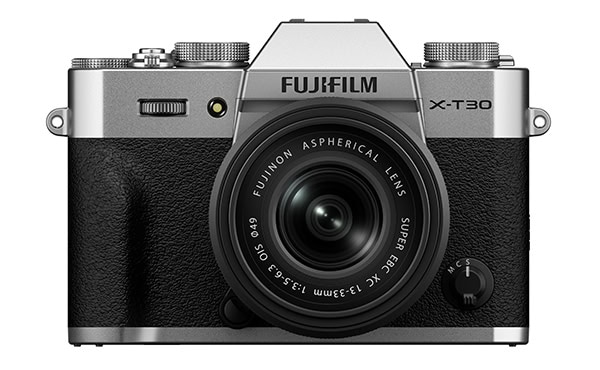
Fujifilm specifies a 26.1MP APS-C X-Trans CMOS 4 sensor paired with X-Processor 5. The camera weighs 378g with battery and memory card and includes an electronic viewfinder, physical controls, current subject-detection autofocus, and the Fujifilm X mount.
Why photographers may enjoy its controls
The X-T30 III combines direct physical controls with an Auto mode for beginners who want the camera to handle more decisions when necessary.
That makes it interesting for someone who wants to learn exposure and photographic controls while retaining an easy fallback for fast-changing situations.
Its compact body is a strength, although independent review from Amateur Photographer notes that the viewfinder is small and some controls can be easy to disturb. Handling is personal, so trying the camera in hand before purchase is worthwhile when possible.
JPEGs and Film Simulations
Fujifilm specifies 20 built-in Film Simulations on the X-T30 III.
These are in-camera rendering options that change characteristics such as color and tonality. Their practical value is choice: a beginner can create different JPEG looks in the camera and may spend less time editing every image immediately.
They do not make a photograph automatically “professional,” and one rendering is not objectively better than another. RAW capture remains available when you want greater editing flexibility.
Autofocus and the X-mount lens ecosystem
Fujifilm’s official material lists AI-based subject detection for animals, birds, automobiles, motorcycles and bicycles, airplanes, and trains, while human face and eye detection is handled through the camera’s dedicated Face/Eye Detection functions. Fujifilm regional material also lists additional recognition for insects and drones.
Fujifilm’s US store states that X mount gives access to more than 40 additional XC and XF lenses. Independent review from Amateur Photographer also identifies the lens range as a major strength.
For a beginner, that matters because a useful selection of compact primes, standard zooms, telephotos, and specialist lenses provides room to grow without changing systems.
Why it is not our default budget recommendation
Price is the main reason.
The X-T30 III belongs here as a stretch-budget option, not as proof that a beginner needs to spend more. It also does not provide sensor-shift IBIS for still photography. Fujifilm promotes digital stabilization for video, while the XC13-33mm kit zoom includes optical image stabilization in the lens.
If the extra cost means you cannot afford the lens you actually need, a less expensive camera system is the better budget choice.
Who should buy it — and who should skip it
Choose the X-T30 III if still photography is the priority and you are willing to stretch the budget for compact physical controls, Fujifilm’s JPEG options, current autofocus features, and the X-mount lens ecosystem.
Skip it if your budget is strict or if sensor-shift in-body stabilization is a must-have.
Which Beginner Camera Should You Buy?
The best budget cameras for beginners are not necessarily the cheapest cameras, but the ones that best match your photography goals and budget.
Use your main constraint to narrow the choice:
| Your priority | Start with |
| A balanced first camera for most photography | Canon EOS R50 |
| Keep the cost of a new entry-level body/kit low | Canon EOS R100 |
| In-body stabilization and a compact lens system | OM System OM-D E-M10 Mark IV |
| A photography-first experience with a larger stretch budget | Fujifilm X-T30 III |
Local pricing can change this decision. A discounted kit can matter more than a small specification advantage.
Before buying, compare the actual camera-and-lens package available to you, not just a recommended retail price or body-only headline.
Don’t Buy the Camera Body Without Pricing the Lenses
The most important budget lesson in interchangeable-lens photography is simple: you are buying into a system, not just buying a body.
A camera that looks cheaper can become more expensive once you add the lenses your photography requires.
Why the kit lens is often the right first lens
There is no need to replace a kit zoom immediately.
A typical kit zoom covers several useful focal lengths, allowing you to photograph landscapes, people, travel, family, and everyday scenes while discovering how you actually like to shoot.
After some real use, review your photographs. If you repeatedly use the widest end, you may eventually want a wider lens. If you keep zooming to the long end, a telephoto or longer standard zoom may be more useful. If you want more background separation or better low-light capability, a faster prime may make sense.
That is a better purchasing method than assuming every beginner needs a 50mm f/1.8. On APS-C cameras, a 50mm lens also gives a tighter field of view than it does on a full-frame camera. It can be useful for portraits, but it is not automatically the best general-purpose first prime.
Check the cost of your likely second lens
Think about subjects before brands.
For portraits, you may eventually want a brighter normal or short-telephoto lens. For travel and street photography, a compact standard zoom or small normal/wide prime may be more useful. Wildlife and field sports can require a telephoto, where lens cost becomes especially important. For landscapes, the kit zoom may already cover many of the focal lengths a beginner needs.
Search the lens catalog and current prices before buying the camera.
Total system cost matters more than body price
Compare at least three numbers:
- Camera plus kit lens.
- Camera plus the lens you expect to want next.
- Camera plus basic essentials such as a memory card and, if needed, a spare battery.
A body that saves $100 today is not necessarily cheaper if your next useful lens costs hundreds more than an equivalent lens in another system.
Should a Beginner Buy a Used Camera Instead?
Buying used can be one of the best ways to stretch a photography budget, especially when the alternative is spending nearly everything on a new body and leaving little for lenses.
An older camera does not stop taking good photographs because a newer model exists.
When used makes sense
Used is particularly attractive when you can buy an established body in good condition and redirect the savings toward a better lens.
A model such as the Sony a6400 illustrates the idea: it is an older APS-C mirrorless camera with an electronic viewfinder and access to the broad Sony E-mount ecosystem. Whether it is a good deal depends on the actual used price, condition, and what lenses you need—not its age alone.
What to check before buying used
Inspect the sensor and lens mount, test buttons and dials, check the screen and viewfinder, confirm autofocus and card recording, and examine the body for impact or moisture damage.
Check battery condition and what accessories are included. Shutter count can provide useful context on cameras where it is reliably available, but it should not be the only condition metric.
Most importantly, buy from a seller with a clear description and a return or warranty policy you understand.
Features Beginners Should Actually Care About
Camera specifications are useful only when they affect your photographs or the way you work.
Autofocus
For family, pets, events, and action, reliable autofocus and straightforward subject selection matter more than a large headline number of AF points.
If you mainly photograph landscapes or still life, sophisticated tracking may be much less important.
Viewfinder and screen
An electronic viewfinder can make composing in bright conditions easier and lets you hold the camera to your eye. A tilting or articulating screen helps with low and high angles.
Touch controls are not essential, but they can make focus-point selection and menu navigation more familiar to someone moving from a smartphone.
IBIS
In-body stabilization can reduce blur caused by camera movement at slower shutter speeds. It is useful, but it is not mandatory for a beginner, and stabilized lenses can also help on systems without IBIS.
Remember that stabilization cannot stop subject movement. Shutter speed still matters. If exposure controls are new to you, Photography.ma’s ISO, Aperture, and Shutter Speed Explained guide covers how the three settings work together.
Lens ecosystem
Bodies are replaced; lenses often stay in a camera bag much longer.
Before choosing a mount, check whether it has affordable lenses for the subjects you expect to photograph. Look beyond expensive professional lenses and examine kit zooms, compact primes, telephotos, macro options, and reputable third-party choices where available.
Size and ergonomics
Compare the complete camera-and-lens combination. A small body with a large lens may not create a small kit.
Grip comfort, dial placement, viewfinder size, and screen movement can affect whether the camera feels easy to use. If possible, handle your shortlisted cameras before buying.
Video — only if you actually need it
Do not pay for video features you will rarely use.
If your primary goal is vlogging or creator video rather than still photography, video-first models such as the Sony ZV-E10 II or Fujifilm X-M5 may deserve separate consideration. They are not main picks here because this guide prioritizes beginner photography.
What to Avoid When Choosing a First Camera
Avoid buying on megapixels alone. Sensor format, lens quality, autofocus, handling, and technique all matter.
Avoid choosing a body before checking lens prices. The mount is part of the purchase.
Avoid assuming you need IBIS. It is valuable for some subjects, but it will not freeze moving people, animals, or sports.
Avoid assuming the newest model is automatically the best value. Older or used cameras can make excellent photographs and may leave more money for lenses.
Avoid replacing the kit lens just because someone says beginners need a fast prime. Use the kit lens long enough to learn what focal lengths and limitations actually matter to you.
And avoid stretching the budget so far for the camera body that you cannot afford the lens you need or the time and experiences that will actually help you learn photography.
Final Buying Checklist
When comparing the best budget cameras for beginners, consider the camera body, first lens, autofocus, ergonomics, and future upgrade costs together. Before ordering your first camera, answer these questions:
- What is my total budget including a lens?
- What subjects will I photograph most often?
- Do those subjects require strong tracking autofocus?
- Do I need IBIS for handheld static scenes, or is it merely nice to have?
- Do I want an electronic viewfinder?
- Is a movable touchscreen important to me?
- Will I actually carry this camera-and-lens combination?
- How much does my likely second lens cost?
- Is there a better used option at the same total budget?
- Am I paying for video features I do not need?
Once you have the camera, resist the urge to keep shopping before learning it. Start with the lens you own, understand the controls, and practice deliberately. Photography.ma’s Best Camera Settings for Beginners guide is a useful next step.
The best beginner camera is not the one with the most impressive specification sheet. It is the system that fits your subjects and budget well enough that you can stop comparing cameras and start making photographs.